![logga.png]](https://forum.higher.nu/hs-fs/hubfs/logga.png?height=40&name=logga.png)
Personality test
The tests that Higher uses come from Psykometrika AB. With experience from several surveys in different industries, we have identified two of the basic success factors that characterize good employees, regardless of industry.
Psykometrika has developed a screening test with 33 questions containing the factors Work Motivation & Self-Confidence, which is a normative test on a norm group of about 15,000 candidates.
The test is based on the Five Factor Theory (Big Five). This should not be seen as a result but rather as an indication. The scale is between 1-9 and measures work motivation and self-confidence. The tests are adapted according to the EFPA standard (European Federation of Psychologist's Associations) and have high Validity and Reliability.

Work motivation - how committed you are to your work and want to perform
Self-confidence - trusting your ability and daring to take initiative
When this module is completed, you will see a figure corresponding to work motivation and self-confidence. The candidate will also receive a summary based on their results.
What's a good result in the personality test?
Work motivation:
Low scores (1-3), The person is not particularly involved in the work. There can be many reasons for this, which should be discussed with the candidate. There is probably another explanation that is outside the work itself, which makes the person prioritize something else. Although there is still a risk that a lack of participation will adversely affect performance. At the same time, people at this level do not set a particularly high standard for the work itself. in fact, people with very low scores are rarely very involved in the organization's goals or development. They may want a job to go to, but do not plan to make a career out of it and do not want any major changes in their professional work. They often work for long periods without moving to another workplace. They are probably not even disturbed by monotonous and repetitive tasks. Although they may appreciate their colleagues and workplaces, they have no clear ambitions for their careers. They probably think it's more fun not to be so involved in the work itself.
Moderate score (4-6), This person will mainly perform well in their work. They are like the average person, although other engagements sometimes prioritize work. Perhaps the individual has an urgent obligation in his spare time, perhaps a parent of a small child, and so on. But the individual performs basically well at this level, about as much as you can expect. Individuals at this level have an underlying competitive instinct, but it does not always come first.
High score (7-9) on this factor, the person has a strong desire to present results. That person is probably really interested in their profession and their job. A person with such a high score will always strive to participate in the organization's goals and development. They want to be involved and influence and 'win'. Of course, this is a crucial factor for success. The person feels strongly motivated and committed to his or her work, which leads to an above-average performance. There is a risk that these people may neglect their privacy and prioritize work before anything else. Sometimes the competitive instinct can take over and the person in question will go 'over and beyond' to achieve the desired goal. There may also be a risk of burnout, which should be monitored during job interviews or when references are taken. High scores on this factor are easily comparable to scores if a person also has high scores in this test, it seems that he or she experiences a conflict between work and private life. This is not sustainable in the long run.
Self-confidence:
Low score (1-3) People with low scores do not have a very high self-confidence. They are basically afraid of failure. The impression is that the person therefore easily allows himself to manipulate himself and there is a risk that others may make too much of an impression on them and their decision. This can create problems especially at management or decision level, when you do not dare to make decisions based on your own competence, ability or assessment. There is a risk instead of trusting the authorities too much or letting colleagues have too much influence over the decisions made. The risk is particularly great if you are forced to make decisions under great uncertainty. People with low scores on these factors tend to make less rational decisions.
Moderate score (4-6) People with moderate scores have a fairly normal view of themselves and their abilities. They are about as human beings in general. In some situations, they allow themselves to be manipulated or influenced. In other situations not at all. Sometimes he or she has a great influence, other times not at all. Sometimes they have doubts about their own abilities and rather avoid making their own decisions.
High score (7-9) People with high scores on this factor have a very strong belief in themselves. He or she has a strong inner self-confidence, a belief in his or her own ability and ability to handle even the most difficult tasks. People with such high scores find it easy to make long-term plans that they will implement. The advantage is that these individuals are emotionally grounded and have a strong self-image. The downside is that these people rely on their own abilities so much that they can underestimate and neglect the skills of others.
Personality tests in job ads/templates
If you want to include personality tests in your job ads/templates, this needs to be added as a module before publication. You cannot add or remove personality tests in an already published ad. This is because you cannot change the conditions for candidates who have already applied for the job via the same ad.
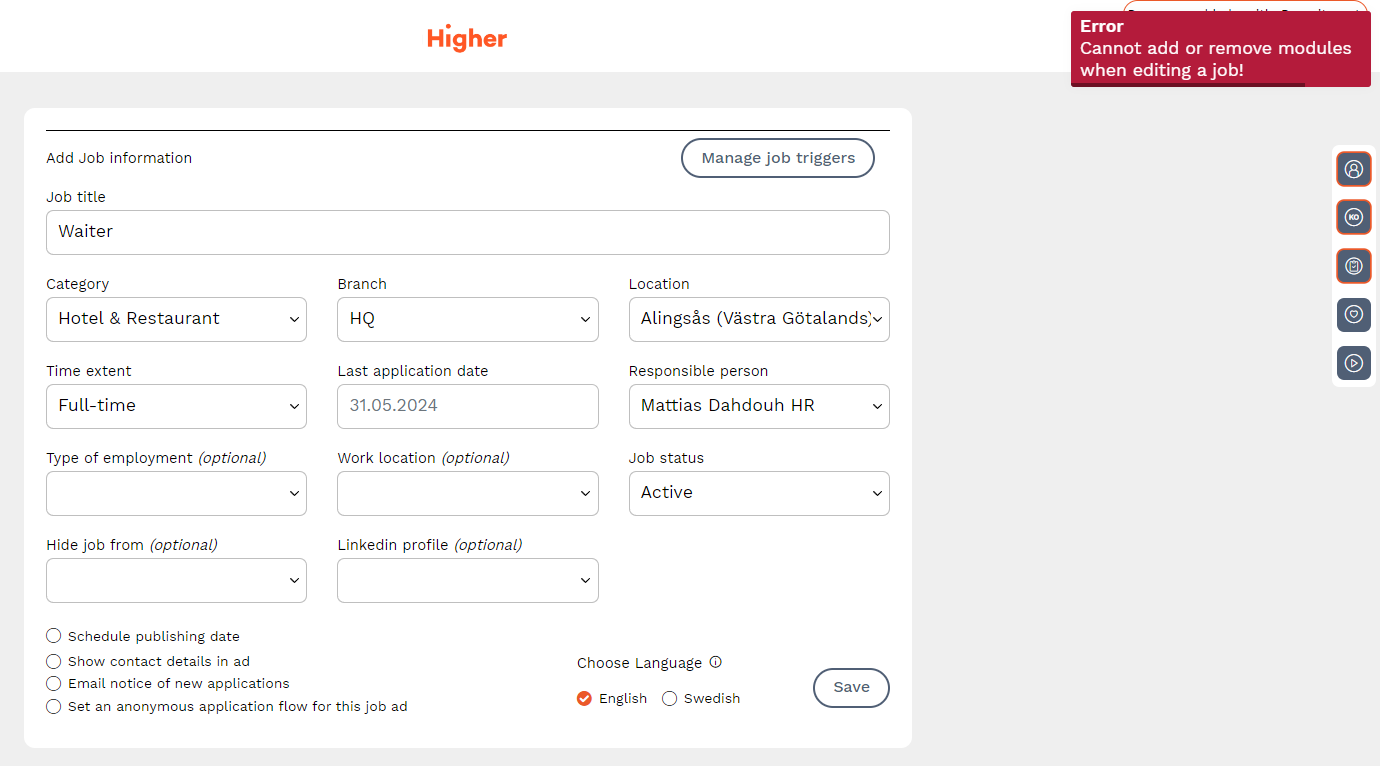
❌ You cannot add or remove the personality test module in a already published ad.
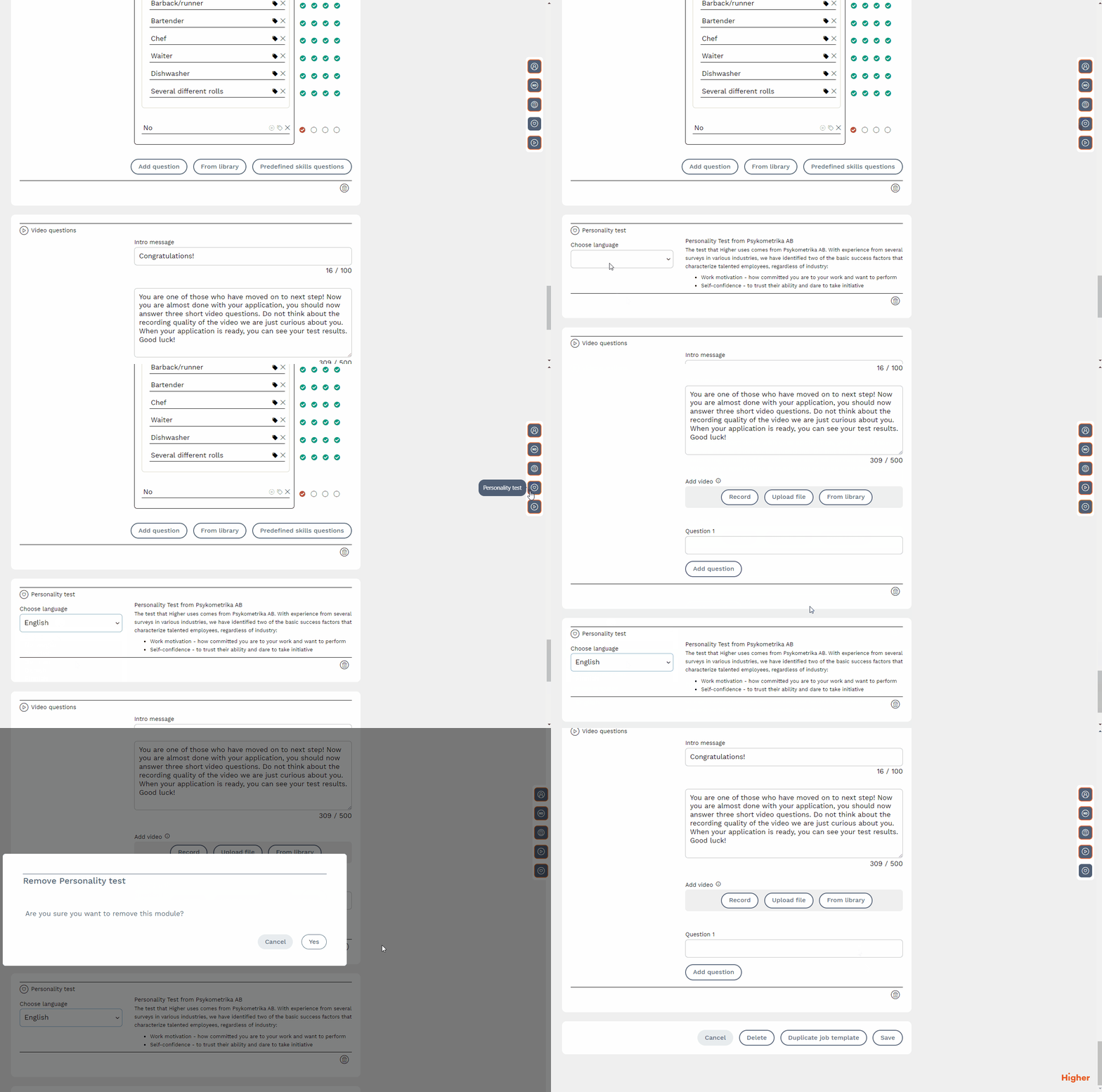
When you activate the module, you have to choose the language in which the test will be shown. By dragging and dropping the icon, you determine the location of the module. Tap the trash can or the symbol to your right if you want to remove the module from your job ad.